
Issuing Unaffordable Dividends Comes at a Cost
Paying out unsustainable dividends may feel good now, but it threatens essential services, future dividends, and our economic stability
For decades, oil paid for Alaska’s schools, roads, public safety — and our Permanent Fund. But today, oil alone can’t cover all the bills. That’s why Alaskans created the Permanent Fund — now over $85 billion — to help pay for essential services, like schools, Medicaid, public safety, roads, etc., when oil could no longer pay for it all.
Some want to overspend the Fund to pay a jumbo dividend. That would result in fewer services and needed capital investments, along with a Permanent Fund that’s no longer permanent. That also means we will need new taxes that raise the cost of living and hurt jobs.
We all want a dividend — but not at the cost of our future. If we live within our means, Alaska can protect essential services, avoid new taxes, and keep an affordable dividend without overspending the POMV limit for generations to come. Learn how Alaskans can have it all by watching this video.
Alaskans for Common Sense supports the largest dividend we can responsibly afford. We can have it all if we do the following:

Don’t add new taxes to get bigger PFD
Do not increase taxes on our resource industries, businesses, or individuals in a manner that threatens further investment, economic development, and prosperity for Alaskans. It is possible that additional taxes may be needed in the future to support essential services, but it makes no sense to impose higher taxes simply to pay out an unsustainable dividend.

Don’t spend the Permanent Fund principle
Do not violate the annual 5% Percent of Market Value (POMV) draw from the Permanent Fund. This 5% allowable draw is the law and is an effective spending limit on government services and the dividend. Overdrawing the fund is reckless. It reduces long-term earnings and our ability to pay dividends, maintain low taxes and support essential state services. The POMV rule is designed to provide a predictable revenue flow today while protecting the Permanent Fund for our children.

Protect investment in roads, schools, and disaster preparedness
Do not destroy essential state services or capital investment. We must be responsible in our spending, and continue to cut unnecessary expenses, while still supporting the essential needs of Alaskans. Annual investment in such necessities as infrastructure, deferred maintenance, and education is critical for future economic growth.
How much does it cost to issue the annual PFD?
The 2025 $1,000 Permanent Fund Dividend cost roughly $685 million — making it one of the largest single line items in the State of Alaska’s budget. The Governor’s proposed full dividend of $3,600 would have cost about $2.3 billion with lawmakers1 estimating the state would need to draw $1.5 billion from the Constitutional Budget Reserve (CBR), the secondary savings account for unexpected costs.
For context, the CBR balance is currently around $2.8-$3 billion. This savings account is necessary for emergencies, budget shortfalls, and cash flow and we need to maintain this minimum balance. Taking $1.5 billion from it would reduce it by half – just to pay an oversized dividend.
How many new revenue sources would be needed to pay for a full PFD?
- The Alaska Legislature estimates that a sales tax of around ~1.9 % could raise roughly $640 million (with groceries exempt).2
- A state personal income tax would net approximately $700 million a year at a rate of 1.6% on annual gross income.3
- Proposals to double Alaska’s motor fuel tax (from 8¢ to 16¢ per gallon) and double the marine fuel tax (from 5¢ to 10¢ per gallon) would raise approximately $30 million to $35 million per year.4
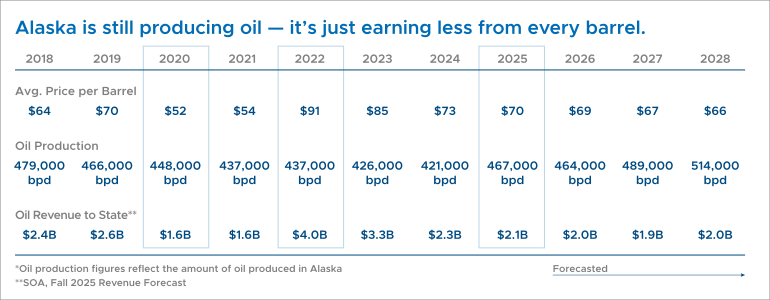
Stable oil production, shrinking revenue: While Alaska’s oil output is slightly increasing, falling oil prices continue to reduce the value of every barrel.
What Others Are saying
- “Why does a state with a $86.4 billion fund constantly struggle with a budget deficit?” Commonwealth North forum, Anchorage, April 16, 2026
- “Alaska has bigger needs than fattening the dividend.” Editorial Piece by Larry Persily, March 3, 2026
- “The Legislature is back. Don’t let one big idea eat the whole session.” Editorial Piece by Anchorage Daily News, January 17, 2026
- “Alaska’s Budget Problem isn’t the dividend – its fiscal honesty.” Opinion Piece by Angela Rodell, January 13, 2025
- “It’s tinfoil hat time for the Permanent Fund endowment plan.” Opinion Piece by Bruce Tangeman, January 9, 2025
“The Permanent Fund was not created as a personal entitlement program. It was established as a long‑term savings mechanism—designed to convert a finite, nonrenewable resource into enduring financial security for future generations of Alaskans.” Read More…
“The PFD has been a significant component of the budget, to the point that paying the dividend has short-changed other vital Alaskan programs such as education, law enforcement, transportation and state government employee compensation.” Read More…
Bill Corbus, retired businessman, Juneau, AK
Sources: