
Things To Know
A sustainable approach makes good sense.
Is the Alaska Permanent Fund Alaska’s Rainy-Day Fund?
The Alaska Permanent Fund was created in 1976 to save and invest a portion of Alaska’s oil wealth. Its purpose was clear: when oil production declined, investment earnings could help replace lost oil revenue and continue funding essential state services — without relying solely on taxes.
Today, the Permanent Fund has grown into one of the largest sovereign wealth funds in the world. In Fiscal Year 2027, it is expected to contribute approximately $4 billion to the state budget. By comparison, oil revenue is forecast at about $1.44 billion, assuming oil prices average $62 per barrel.
Even with this support, maintaining a $1,000 Permanent Fund Dividend in the coming years will require difficult choices — either new taxes or additional deficit spending — unless Alaska lives within its means and uses the Fund responsibly.
Understanding Alaska’s Budget
The simplest way to understand Alaska’s budget is to think of it like a household budget with three main buckets — except Alaska relies heavily on investment income rather than wages. Because the state has no statewide income or sales tax, it pays most of its bills using earnings from the Alaska Permanent Fund, along with oil and gas revenue, federal funds, and savings when needed.
The largest and most important source of funding is the Alaska Permanent Fund. The Fund is a long-term investment account, and each year the state uses a structured draw — known as the Percent of Market Value, or POMV — from investment earnings. This draw pays for the core of Alaska’s budget, including government services such as schools, public safety, roads, Medicaid, and disaster response, as well as the Permanent Fund Dividend. Understanding how the Permanent Fund works is key to understanding Alaska’s finances.
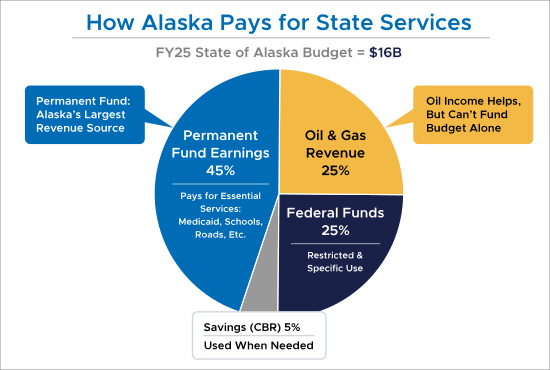
Alaska still receives revenue from oil and gas taxes and royalties, but far less than in past decades. Oil revenue now helps support the budget but can no longer fund state government on its own. Federal funding also plays a significant role, especially for transportation, Medicaid, and major infrastructure projects, though most of this money is restricted and cannot be spent freely. When state spending exceeds available revenues, Alaska relies on its savings — primarily the Constitutional Budget Reserve — to fill the gap.
Takeaway: Alaska’s budget depends on careful management of the Permanent Fund, responsible spending, and living within our means to keep essential services and dividends sustainable.
Sustaining Alaska’s Future: Responsible Use of the Permanent Fund and Budget Reserves
Alaskans for Common Sense believes Alaska’s long-term prosperity depends on responsible, sustainable fiscal management. State budget data shows that oil revenue alone has not been sufficient to fund essential services for many years, leading to increased reliance on savings accounts like the Constitutional Budget Reserve (CBR) and the Permanent Fund’s Earnings Reserve.
In 2018, the Legislature passed Senate Bill 26, establishing a rules-based approach for withdrawals from the Permanent Fund using the Percent of Market Value (POMV) method. Under this approach, annual withdrawals are generally limited to 5% of the average market value of the Permanent Fund over the first five of the preceding six fiscal years, providing a predictable and sustainable draw while protecting the fund’s principal. Meanwhile, frequent use of the CBR over the last decade has significantly reduced its balance, limiting its usefulness as a safety net for future downturns.
We advocate for prudent, rules-based use of these resources to ensure essential services are maintained, the Permanent Fund is preserved for future generations, and Alaska remains fiscally stable despite volatile oil markets and North Slope production that is well below its 1988 peak of 2.03 million bpd.
The Alaska Permanent Fund Dividend Program
In the 1970s, Alaska discovered that oil wealth was temporary. Voters and lawmakers decided that some oil money should be saved forever and shared with all generations of Alaskans.
In 1976, Alaskans voted to create the Permanent Fund. The Dividend Program began in 1982. Originally, the dividend was calculated based on 50% of the fund’s realized earnings over the prior 5 years, divided by the number of eligible residents. Today, the Legislature decides the amount each year starting with an amount specified in the Governor’s budget. Today’s dividend comes out of the annual Permanent Fund earnings draw (POMV). The first PFD was $1,000 (1982) and the highest PFD was $3,284 (2022). Here’s a timeline of Alaska Permanent Fund Dividend (PFD) amounts from 1982–2025.
It’s Time to Choose a Path to Guarantee Alaska’s Fiscal Future
With current revenues and expenses, Alaska can maintain essential state services at roughly today’s level while supporting modest Permanent Fund Dividends — without imposing new state sales or income taxes.
Alaska’s ability to fund “affordable PFDs” depends largely on oil revenue, which still provides about one-fourth of the state’s annual budget. In years of high oil prices, an affordable dividend could exceed $1,000. In years of low prices, it might drop to $500 or less.
Proposals like the 50:50 Plan, which splits the annual 5% draw from the Permanent Fund between dividends and state services, would cost $600–700 million more per year than we can afford without major new taxes or drastic budget cuts as oil prices normalize. Another option, a 75:25 split, also requires new taxes, albeit less than the 50-50 plan. Neither plan favors essential services – both put the dividend above state services.
Alaskans for Common Sense is not advocating for a specific plan — but fiscal modeling shows that a balanced, sustainable approach is the only way to protect both dividends and essential state services. But it may not be enough. At low enough oil prices, there would not be sufficient monies to fund PFDs once essential state services are funded.
Stay involved in the conversation
Watch our video to learn how we can avoid unnecessary taxes and still pay for core services.
Watch Video